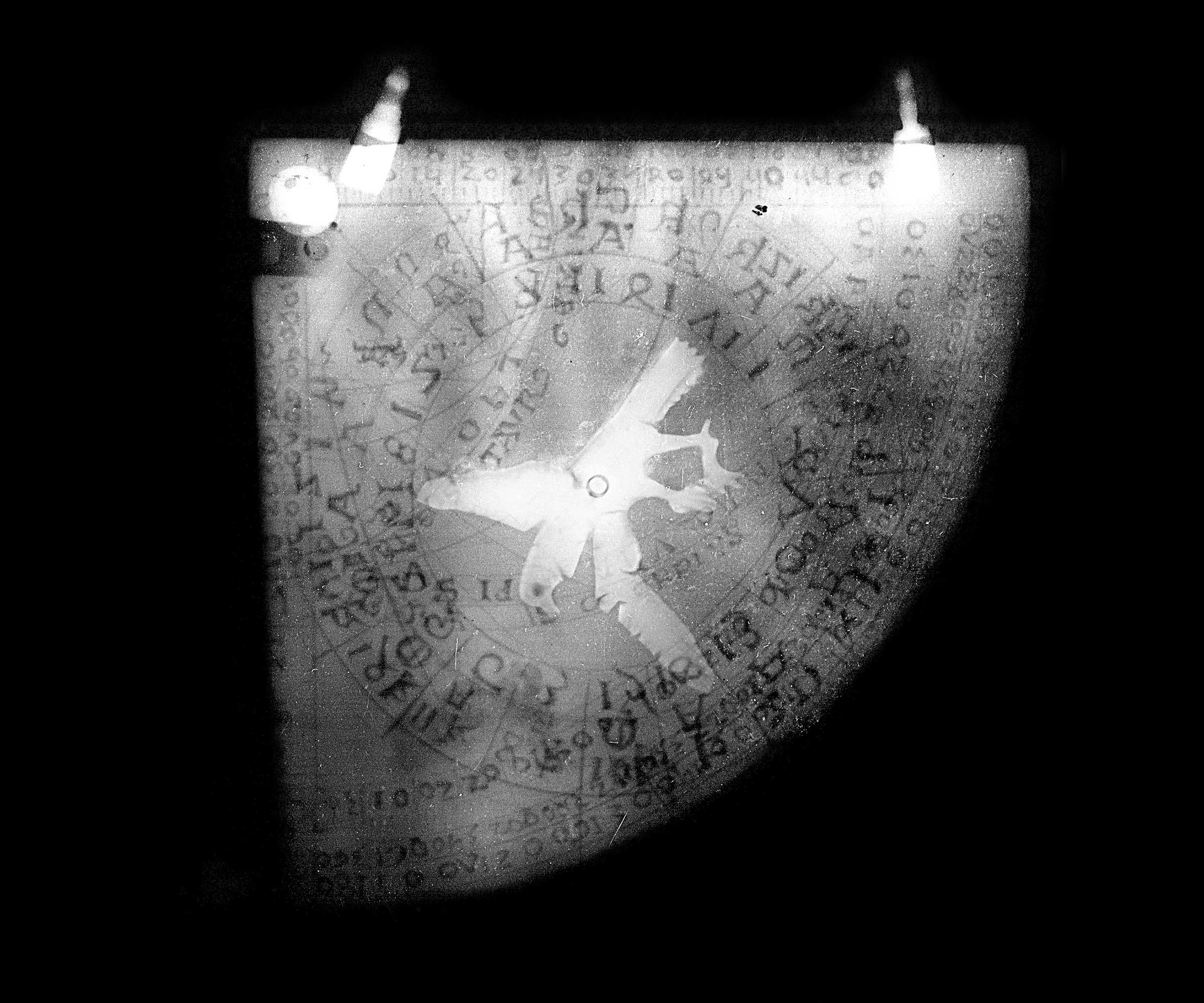


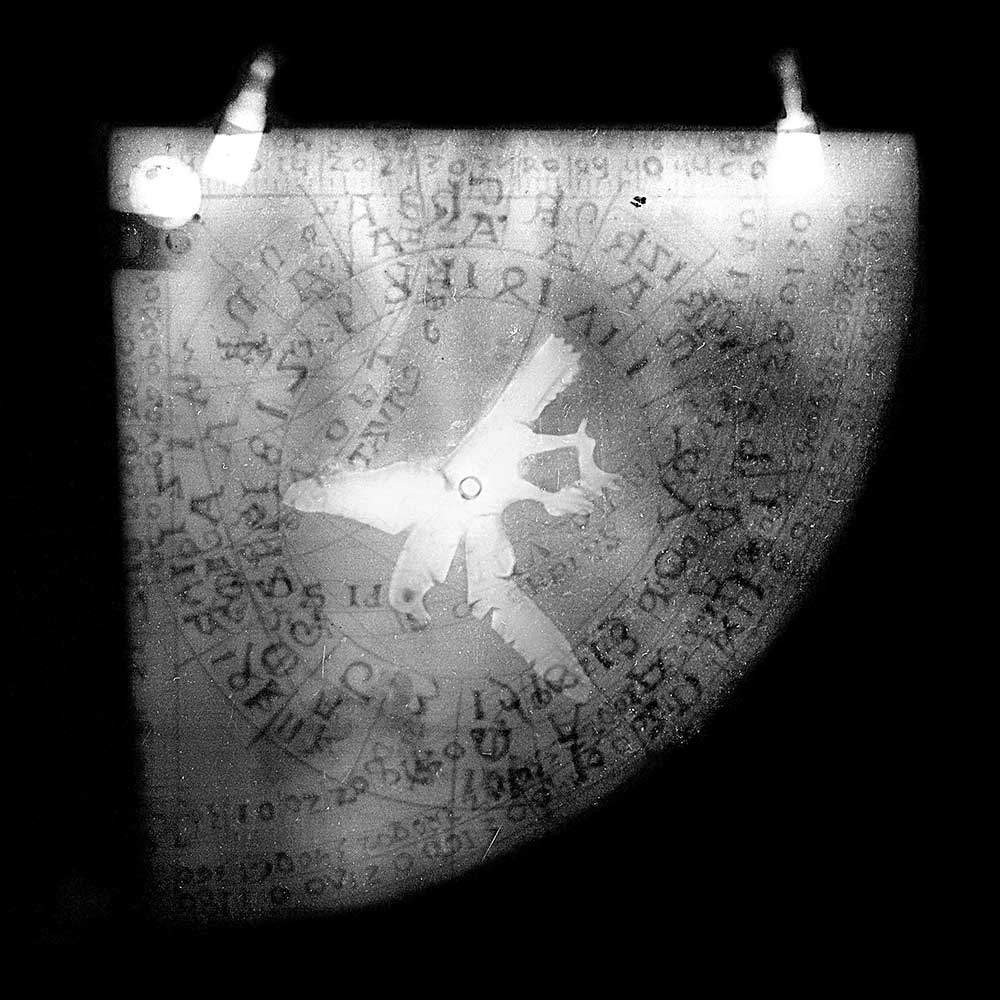
QUADRANS NOVUS or ASTROLABIC QUADRANT – SCIENTIFIC BRASS INSTRUMENT,
HOUSE OF AGNES, 71 ST DUNSTAN’S STREET, CANTERBURY
This object was found during an archaeological watching brief in 2005 on building works to the rear of The House of Agnes – an early seventeenth-century historic building in St Dunstan’s, Canterbury. The object was found amongst domestic refuse from a medieval pit and it was immediately clear that the find was special.
Date: Medieval (circa 1300s, possibly 1388 AD)
Origin
Identified as an astrolabic quadrant, this object is a rare medieval scientific instrument. Astrolabic quadrants were used for many purposes including basic surveying, telling the time, and using the Sun to calculate calendrical events. During the medieval period, this type of object was known as a quadrans novus.
According to a specialist report in 2010, only seven such objects from medieval times have been found, hence its rarity. The object is made of a copper-based alloy and, to date, forms the smallest of the medieval quadrans novus found so far. The object is very similar to a quadrant preserved in Oxford Merton College.
Use
The front side of the object reveals it was used to find the time during the day by means of the altitude of the Sun. The reverse side of the object shows two concentric rings with calendar related information, in the centre of which is an eagle with its wings spread, fixed to the quadrant by a rivet in the middle, around which it once could turn. The common astrolabe, a predecessor of this find, was first introduced to the Latin West at the turn of the tenth century. Descriptions of the quadrans novus may go back to the twelfth century.
Detailed examination of the instrument concluded that, based on its form and its metallic composition, the quadrans novus was made in England. It was designed to be used solely in England, as shown by the presence of only one horizon for a latitude of 52 degrees
It was made in the fourteenth century, possibly 1388, based on the style of the lettering.
It was made for use only with the Sun, since it depicts no stars or certain other lunar features. The emphasis on the Sun is endorsed by the Eagle, whose association with the Sun goes back to antiquity.
Geometrical problems could be solved by means of the shadow square. The quadrant could also be used for finding the lengths of the day and night, the times of the Sun rising and setting, and the places of sunrise and sunset.
The instrument must have been owned by an educated person as the reader of the astrolabe needed a good understanding of astronomy and trigonometry. Therefore the owner would have been amongst a small circle of scientifically educated scholars in fourteenth-century England. The small size of the instrument suited a traveller who is likely to have kept it in a leather case. The loss of this object would have been extremely upsetting for its owner!
Discovery
Archaeological monitoring during the cutting of building foundation trenches at the rear of The House of Agnes revealed a number of archaeological features, including Roman pits, a medieval masonry-lined well and a post-medieval kiln.
The astrolabe was recovered from the backfill of a large, later medieval pit. The pit contained typical medieval domestic refuse of animal bone, oyster shell and peg-tile with an assemblage of pottery sherds dating between circa 1150 and 1400. The brass quadrans novus or astrolabic quadrant was found amongst this material.
Current Location
The original object is now part of the collection of the British Museum.
Catalogue Entry
Site code: HOAC WB 05
Brass astrolabic quadrant. Context (13) from pit [156]. The instrument measures 1.5mm thick. One side of the quadrant is 67.3mm across and the other is 67.6mm. There are two sight vanes with holes of about 1.5mm diameter fixed by rivets on one edge with approximate dimensions: height 11.7mm, width of the base 3.7mm, depth 3.4mm. There is a suspension with a hole for a now lacking silken cord with bead at the corner of the object, fixed by a rivet around which it could turn. This suspension is now immobilised by oxidation. There are four rivets on the other edge which show repairs have been made to this side of the quadrant. Other damaged areas occur on the front (just above the equator and another close to the ecliptic) and the back of the quadrant, all of which are caused by oxidation.
Catalogue entry based on a description by Elly Dekker
A full report on the object can be viewed here: