

CLAY LOOMWEIGHTS,
THANET EARTH, MONKTON
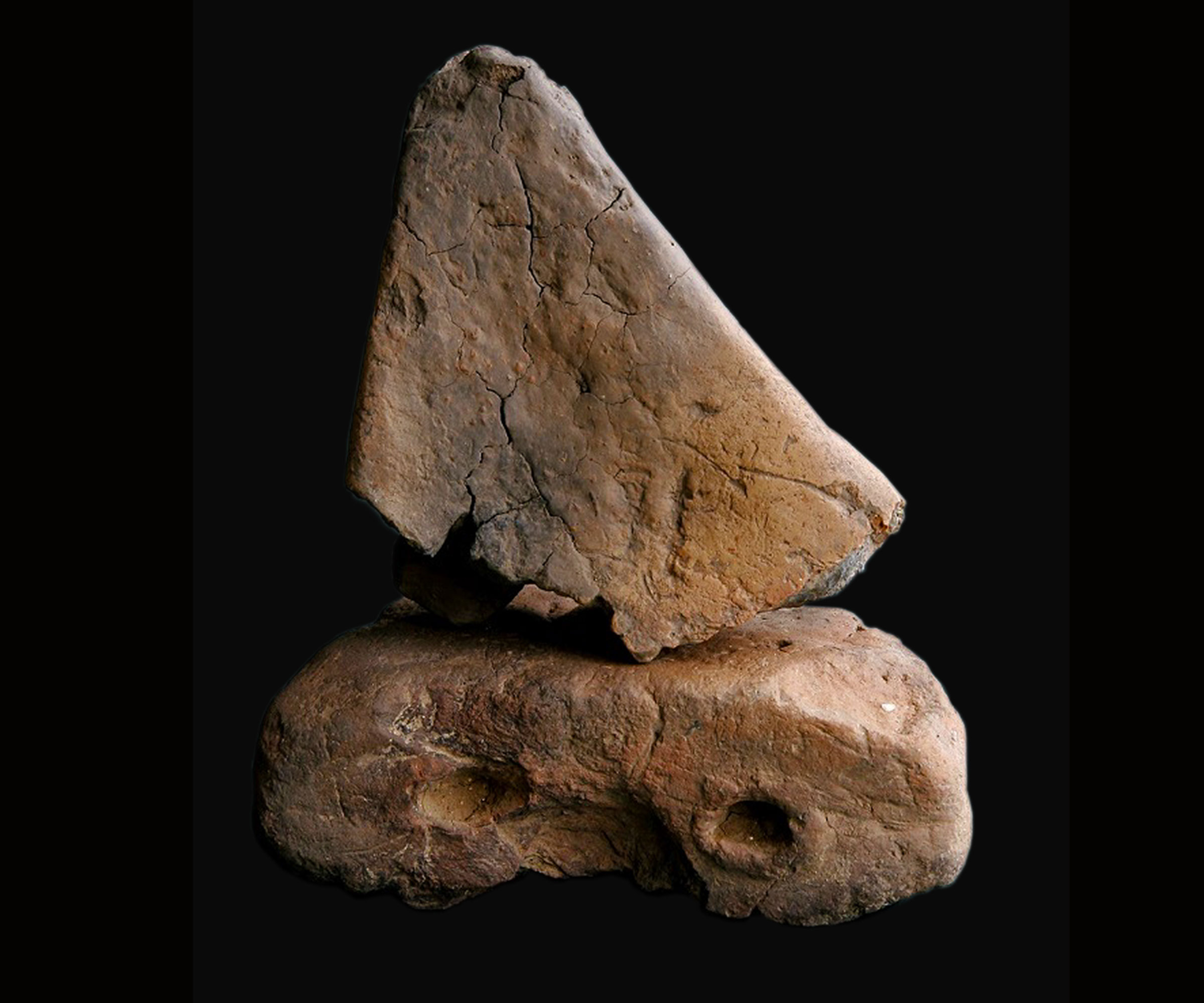
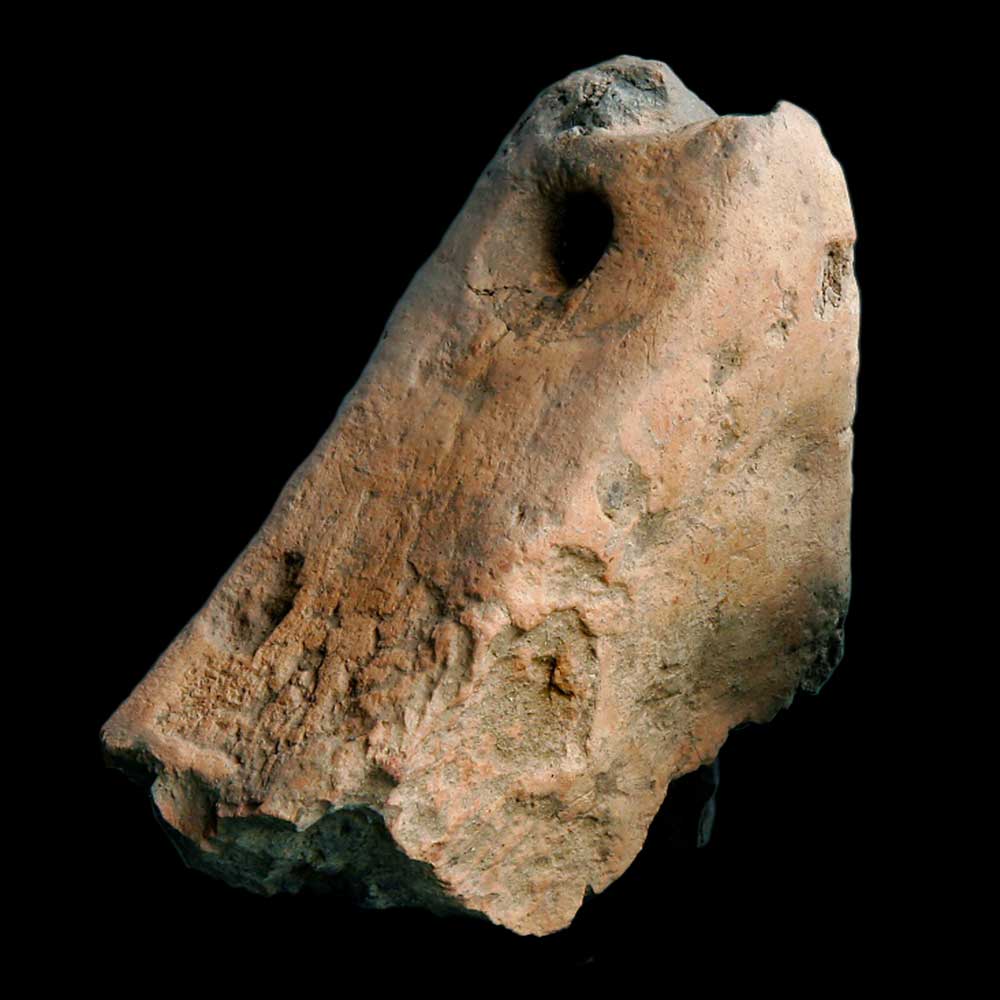
Large-scale archaeological excavations at Thanet Earth in 2007–2008 uncovered a considerable and varied finds assemblage including a well-represented collection of fired clay loomweights dating to the Iron Age. These objects relate to textile production and were mainly retrieved from the fills of storage and refuse pits alongside other associated objects, such as spindle whorls. Most of these artefacts were found within the northern extent of the Thanet Earth development site, designated Plateau 8.
Date: Iron Age (circa 600–300 BC)
Origin
A total of 32 complete or near-complete, triangular clay loomweights or fragments with characteristic loomweight features were found during excavations at Thanet Earth, the majority of which were discovered on Plateau 8. Triangular loomweights date to the Iron Age and are a common find on Iron Age sites in Britain. Based on the contexts from which the loomweights were found, it is likely that all date to 600–300 BC.
The loomweights are made from low-fired burnt clay and most appear to be similar in design and type of clay fabric, indicating they might have been made and used at roughly the same time. The loomweights have generally survived very well with good preservation and in many cases completeness.
Use
Iron Age fired clay loomweights of this shape and form are generally believed to have been used in connection with weaving activities. They would have been suspended from an upright loom, as the name suggests. It is also possible they might have been used for other purposes such as thatch weights. The presence of large numbers of Iron Age loomweights, along with other objects such as spindle whorls, suggests a focus of textile production, particularly weaving activities, on the Plateau 8 area of Thanet Earth during the Iron Age period.
The loom which would have been in use during the British Iron Age was the warp-weighted loom, which had been in use since the Neolithic period but became out-dated in the Roman. . This was a fairly simple loom design which consisted of two wooden uprights and a horizontal bar, which would rest against the wall. The warp (vertical) threads would hang freely from the bar and would be tied individually or in bundles to the loomweights. The clay loomweights hanging from the bottom of the threads would keep them taut enough to enable the weft (horizontal) threads to be more easily passed over and under in the weaving process.
Discovery
In all, the Plateau 8 settlement consisted of some seven hundred features, dominated by 384 pits and 289 post-holes, together with ditches, gullies, ring-ditches and burials. There was also evidence of previous structures on the site including two potential round-houses. The majority of the pits, some of which were exceptionally large, appeared to have been cut for storage and once they fell out of use they were then filled with domestic refuse.
The loomweights were recovered from storage and refuse pits. The large size of the assemblage indicates an unusually intense focus of textile-related activity during the Iron Age period. Four ceramic spindle whorls were also found on Plateau 8 and relate to textile-associated activities, contemporary with the Iron Age loomweights.
Archaeological evidence for the process of textile production is scarce as the wooden looms and associated threads and weaving material do not generally survive well in British soil conditions. The baked clay loomweights and spindle whorls survive far better.
Current Location
The loomweights are currently on display at Thanet Earth.
Catalogue Entry (for the most complete examples)
Site code: TEP8 EX 07
FN 8.27 Context 8628. Large triangular loomweight, broken at one corner. There are two suspension holes through each of the surviving corners. This loomweight conforms to the most common type of Iron Age loomweight, Type 1 (triangular in shape with perforations generally across all three corners). Dark red, hard fired clay. Surviving length: 90 mm, width: 158 mm, thickness: 55 mm. Weight: 1021 grams.
FN 8.122 Context 8637. Large triangular loomweight, broken at one corner. There are two suspension holes through each of the surviving corners. Type 1 loomweight. Buff-pink, hard fired clay with a dark-grey reduced core. Length: 145 mm, surviving width: 120 mm, thickness: 65 mm. Weight: 1112 grams.
FN 8.380 Context 3720. Large triangular loomweight, broken at two corners and across one face. The remains of one suspension hole can be seen at one corner. Type 1 loomweight. Reddish-brown, hard fired clay. Surviving length: 130 mm, width: 130 mm, thickness: 55 mm. Size of surviving oval perforations: c. 10mm x 15mm. Weight: 704 grams.
FN 8.80 Context 3643/3644. Large triangular loomweight, broken at all three corners, all of which were perforated. Type 1 loomweight. Orange-brown, hard fired clay. Surviving length: 104 mm, width: 130 mm, thickness: 55 mm. Size of surviving oval perforations: c. 5mm x 10mm. Weight: 652 grams.
FN 8.28 Context 8659. Substantial remains of a large triangular loomweight, broken into three fragments and at all three corners, all of which were originally perforated. Type 1 loomweight. Orange-brown, hard fired clay with a dark reduced core. Surviving length: 140 mm, width: 90 mm, thickness: 50 mm. Size of surviving oval perforation: c. 10mm x 15mm. Weight: 680 grams.
A reconstructed Iron Age warp-weighted loom at the Peats Moor Centre, Westhay, Somerset shows how the loomweights would have been used:
westhay warp weighted loom – Bing images
Follow this link to view the recently published report for excavations at Thanet Earth: