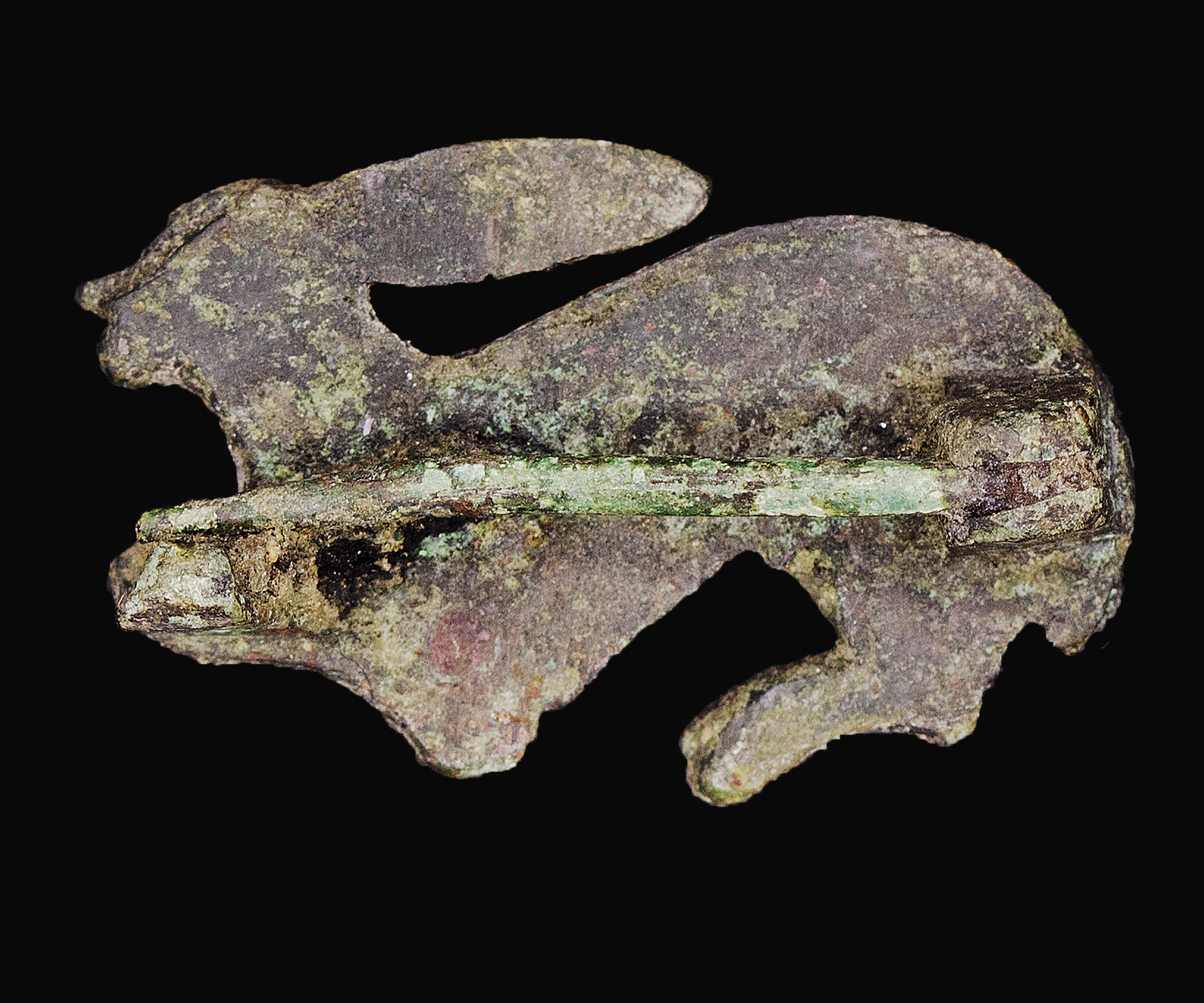


COPPER ALLOY BROOCH,
ROMAN VILLA OVERLOOKING EAST WEAR BAY, FOLKESTONE
This exquisite little brooch, cast in the form of a hare, was found at the Roman villa on Folkestone’s East Cliff, overlooking the waters of East Wear Bay and the Channel.
Date: Roman (circa AD 150–300).
Origin
This brooch is of copper alloy and would have been cast in a mould before being finished by hand. It is plated to give it a silver appearance. Stripes have been created by inlaying a series of grooves with a black substance, probably niello (a mixture of sulphur, copper, silver and lead). A copper alloy pin is attached to the back by a simple hinge, with a catch-plate to hold the pin secure.
It was probably made in south-eastern Britain, perhaps locally, sometime during the second century AD.
Use
Brooches originated in Europe during the Iron Age. At first, they were simply a means of securing clothing, in much the same way that a safety pin (which early brooches resembled) does today. But they soon also took on a decorative or symbolic function. Brooches such as this, depicting a crouching or leaping hare, would have been mainly or solely about decoration, or conveying a symbolic message, and this example is too small to be very effective as a dress fastener.
Brooches depicting hares, and sometimes hounds, have been found across southern Britain. In almost all cases the hare leaps to the right, as with this example. Such brooches may symbolise the wearer’s interest in hunting, specifically hare coursing. Alternatively, or perhaps as well, the brooch may symbolise the hare’s ancient mythological associations with spring, fertility and magic. Or, perhaps, its owner simply liked the appearance of the brooch.
Discovery
The brooch was found in the Summer of 2011 during the excavation of the Roman villa at Folkestone. It was recovered from a deposit overlying the courtyard and had possibly been lost and then redeposited along with a range of other material from the villa after the building became abandoned during the later third century.
Current Location
Canterbury Archaeological Trust Archives. The brooch is due to go on display in Folkestone Museum
Catalogue entry
Site code: ATU/1.
SF330. Copper alloy brooch. Complete zoomorphic plate brooch in the form of a hare. The hare is crouched and facing right, with long ears formed as a single piece sub-divided by a groove. Length: 22mm. Width: 25mm. Height: 14mm. Thickness (including pin on back): 7.5mm. Weight: 4g. Context (500).
This brooch became one of the most recognisable objects found during A Town Unearthed: Folkestone to 1500, a community heritage project led by Canterbury Christ Church University and funded by the Heritage Lottery Fund.

A mischievous impression of the hare which featured in the Earth and Vision exhibition, curated by Bryan Hawkins, as part of A Town Unearthed, April 2012. © Emma Richardson.
More information on the villa can be found in the East Wear Bay Conservation Management Plan.