Origin
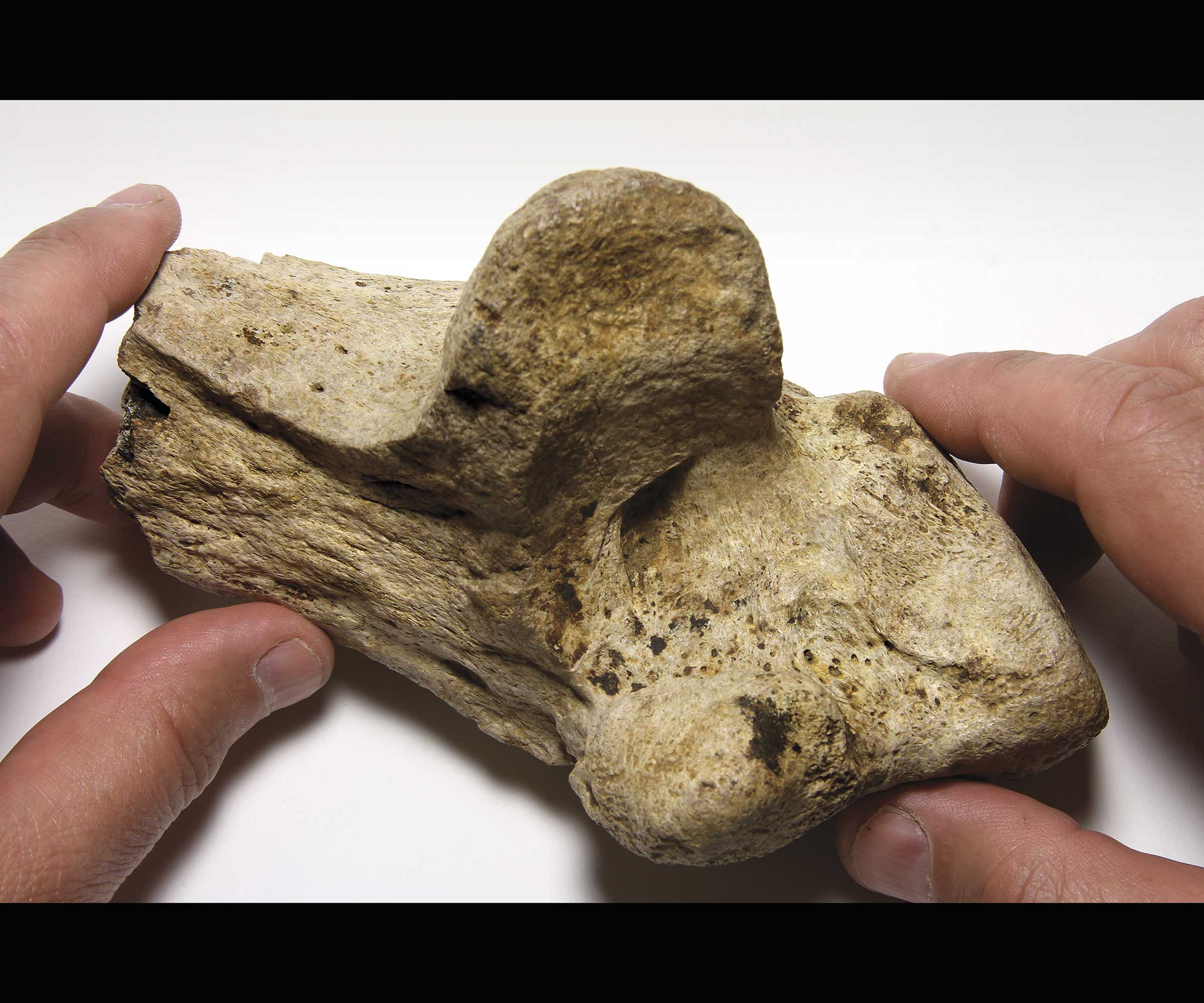
The bone fragments include that of a scapula (shoulder blade; pictured above) that was initially thought to have possibly come from a rhinoceros. However, upon examination by a specialist (Professor Danielle Schreve from Royal Holloway, University of London), this bone and other fragments have been confirmed as hippopotamus remains. At least two hippos are represented, including a young individual, whilst fragments of elephant ivory and part of a rhinoceros tooth have also been identified.
The fossilised bones are from the Pleistocene period, which is a geological epoch that covers a huge stretch of time that dates from about 2.5 million to 11,700 years ago. The end of the Pleistocene corresponds with the end of the last Ice Age, and also the end of the Palaeolithic period (Old Stone Age).
Discovery
Hippo remains have previously been found from the coast at Herne Bay, but they are quite rare in Pleistocene deposits. Hippos are associated with temperate conditions in Britain known as interglacials, which are geological episodes of warmer global average temperatures lasting thousands of years within an ice age (glacials). The last interglacial period in Britain was some 125,000 years ago, during a period that saw significantly warmer summers and milder winters. The species identified at Herne Bay is that associated with the modern day hippo, now restricted to sub-Saharan Africa but previously having a much wider range.
Fossilised hippo remains have been found elsewhere in Britain including as far north as Stockton-on-Tees, County Durham. A larger, now extinct species of hippo (Hippopotamus major) was identified from much older deposits in East Anglia that date to an earlier warm period around 500,000 years ago. It is possible that some of the fossils from the golf course may have come from this earlier interglacial since a well-preserved hippo calcaneum (heel bone; pictured below) from Swale 10 is larger than those seen in modern hippos. Unfortunately the fossils from Herne Bay are too old for radiocarbon dating.
Deep excavation (by machine) of the Swale 10 area revealed that the fossilised hippo remains were recovered from deposits that were not in their original place of deposition, but had washed out within fast-flowing water channels from earlier deposits further upslope. It is therefore possible that undisturbed stratified Pleistocene deposits may still remain in the area.
A scatter of other fossil remains from the site include a fragment of elephant ivory and part of a rhinoceros tooth. The fossils indicate this area was once a water-dominated landscape, some 125,000 years ago and populated by hippos, rhinos and elephant. Appropriately the area where the hippo bones were found is destined to remain a water feature as part of the new development.
The remains of megafauna at Herne Bay Golf Course together with later geological features at the site provide a fascinating insight to very different environments that once existed in the Herne Bay area from the Pleistocene period up to the present day.