

MEDIEVAL TOUCHSTONE, STARR PLACE, ST DUNSTAN’S, CANTERBURY
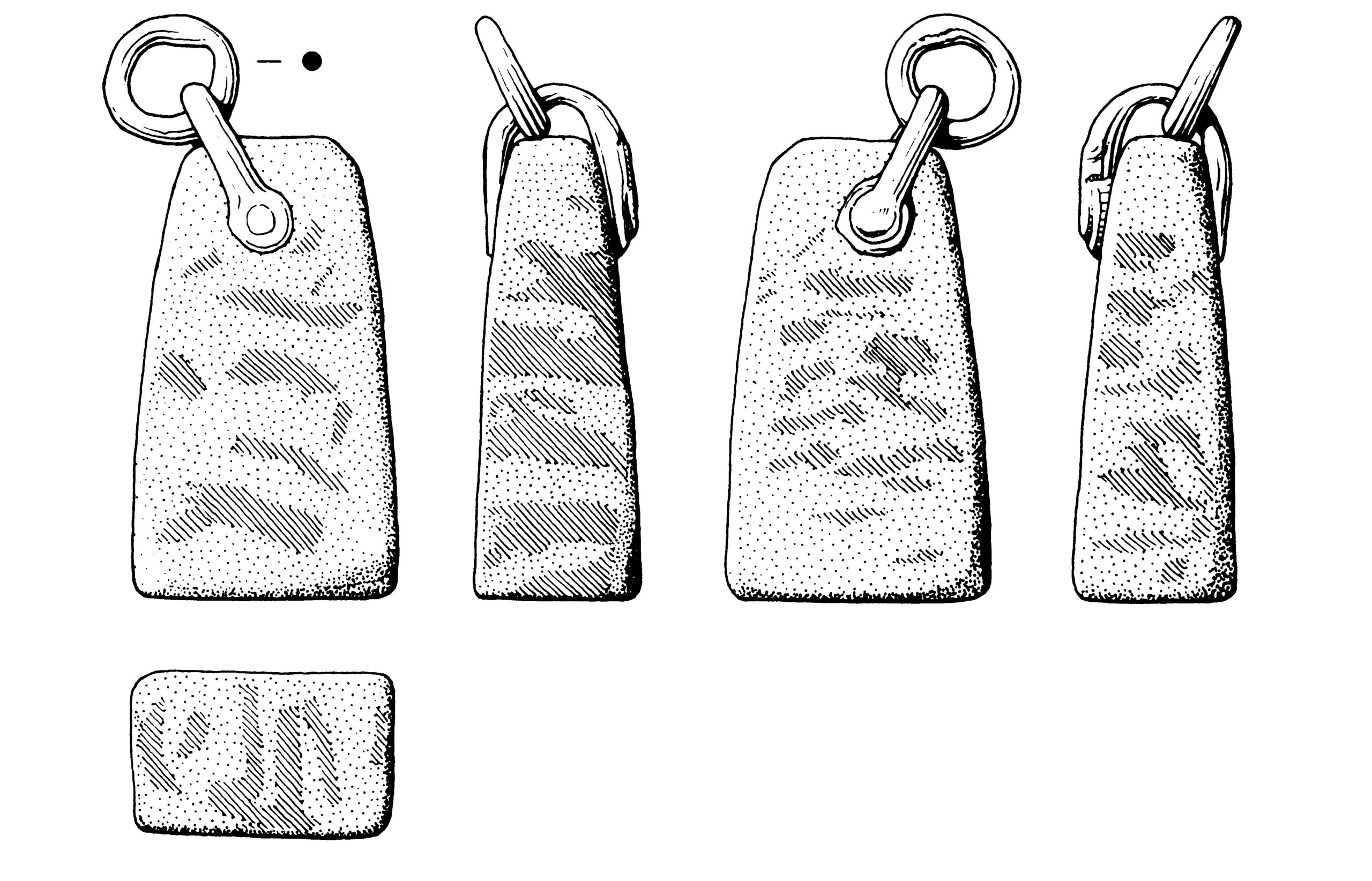
This goldsmith’s touchstone is made of fine black chert or silicified tuff (solidified volcanic ash), and is fitted with a copper alloy shackle and a corroded wire suspension ring. It was used for analysing the purity of soft metals and still shows traces of strikes from the testing of gold objects.
It was found in a pit during an evaluation at Starr Place, St Dunstan’s in 1991.
Date: Medieval
Use
The touchstone is a small, roughly rectangular slab that measures 32mm long and 18mm wide, tapering to 12mm. Its surface shows many gold-coloured scratch marks.
The use of touchstones to determine the approximate purity of gold and silver objects is known to date from as early as the sixth century BC.
To determine the purity, gold (or silver) is scratched or streaked onto the surface of the touchstone and then compared to streaks of a known alloy composition using a set of touch needles. In this example, the set of needles would probably have been suspended from the wire ring together with the touchstone.
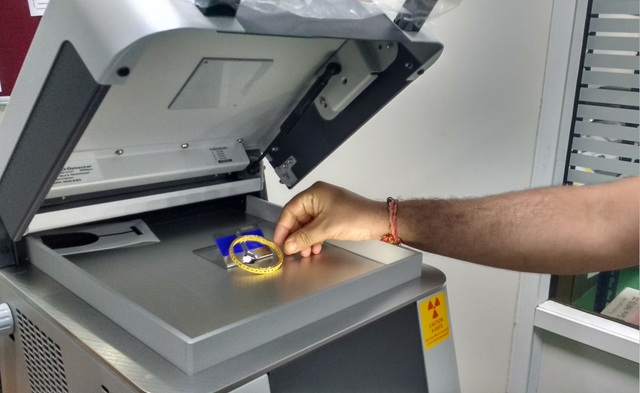
This method of examining the purity of gold is still in use amongst jewellers and gold merchants in some places around the world. Modern techniques include treating the scratches on the touchstone with a chemical reagent that fades the scratch marks. The rate of fading is then cross-checked with known fading standards. More expensive techniques include using an X-ray machine to determine elemental composition and karat value.
A medieval goldsmith in a cathedral city may have produced objects for the church and the local nobility, as well as producing items for the large merchant population within Canterbury.
Aside from the requests of the elite, goldsmiths also produced everyday items, such as belt buckles, chains and jewellery. Repair work would probably have taken up much of their time.
Discovery
The St Dunstan’s parish lies outside the city walls, to the north-west of Canterbury city centre. This extra-mural (meaning outside the walls or boundaries of a city/town) area appears to have been intensely populated throughout the medieval period, possibly because its location just outside the city walls gave certain financial benefits in terms of tax avoidance. St Dunstan’s Street runs north-west through the medieval West Gate and is flanked by many surviving post-medieval buildings. The modern street and property layout appears to lie within medieval burgage (or rental) plots, many of which are preserved within the present-day property boundaries.
A goldsmith working here or close by would have been well placed; adjacent to such an integral route in and out of the city to catch passing trade.
It is notable that this object was found in the St Dunstan’s parish of Canterbury as Saint Dunstan (along with the French Saint Elegius) was the patron saint of goldsmiths. Accounts of Saint Dunstan’s life indicate that, as a monk, he was a skilled craftsman. He had been a silversmith at Glastonbury making church plate before later becoming the Archbishop of Canterbury in c 960 AD.
This object was found during archaeological investigations in 1991 where it was uncovered from the garden area of an associated residence, within the boundaries of a plot that stretches back from St Dunstan’s Street.
During the Roman period, this suburb was predominately industrial in character, with several pottery and tile kilns observed or excavated nearby.
Medieval St Dunstan’s Street replaced the former Roman road. Earlier Roman-period remains were also found within the garden site. These revealed the remains of a Roman period pottery kiln, which was constructed in the early to mid-second century AD.
Later evidence recorded at the site comprised two multi-phase medieval buildings with five pits that yielded late twelfth- to fourteenth-century pottery sherds.
The discovery of this medieval touchstone implies post-Roman continuation of local craft and industry in this area of Canterbury, likely mixed with domestic activity.
Interestingly, it was found not far away from one of CAT’s most spectacular discoveries of metalwork – that of a medieval astrolabe or quadrant.
Current Location
Canterbury Archaeological Trust archives.
Catalogue Entry
Site code: SP 91. Small rectangular slab of black silicified tuff or chert. 32mm by 12–18mm wide.