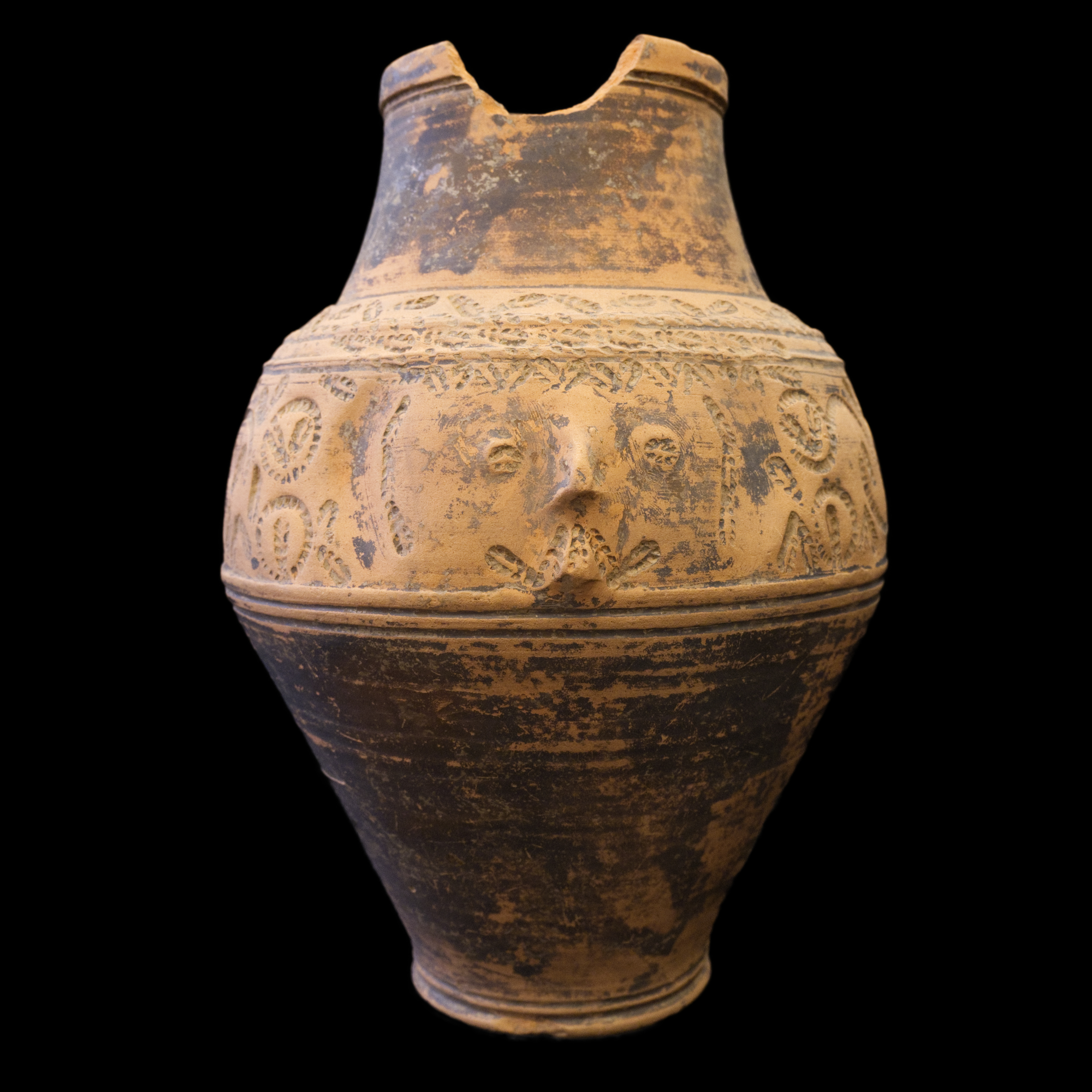


Roman Face Beaker
In the 3rd to 4th century AD, an individual, possibly a woman, was laid to rest just outside of Roman Canterbury. Placed between her feet was a striking ceramic beaker, its surface shaped into a human face. This unusual object was not an everyday vessel but rather had been made for special purposes including ceremonies and rituals.
Production:
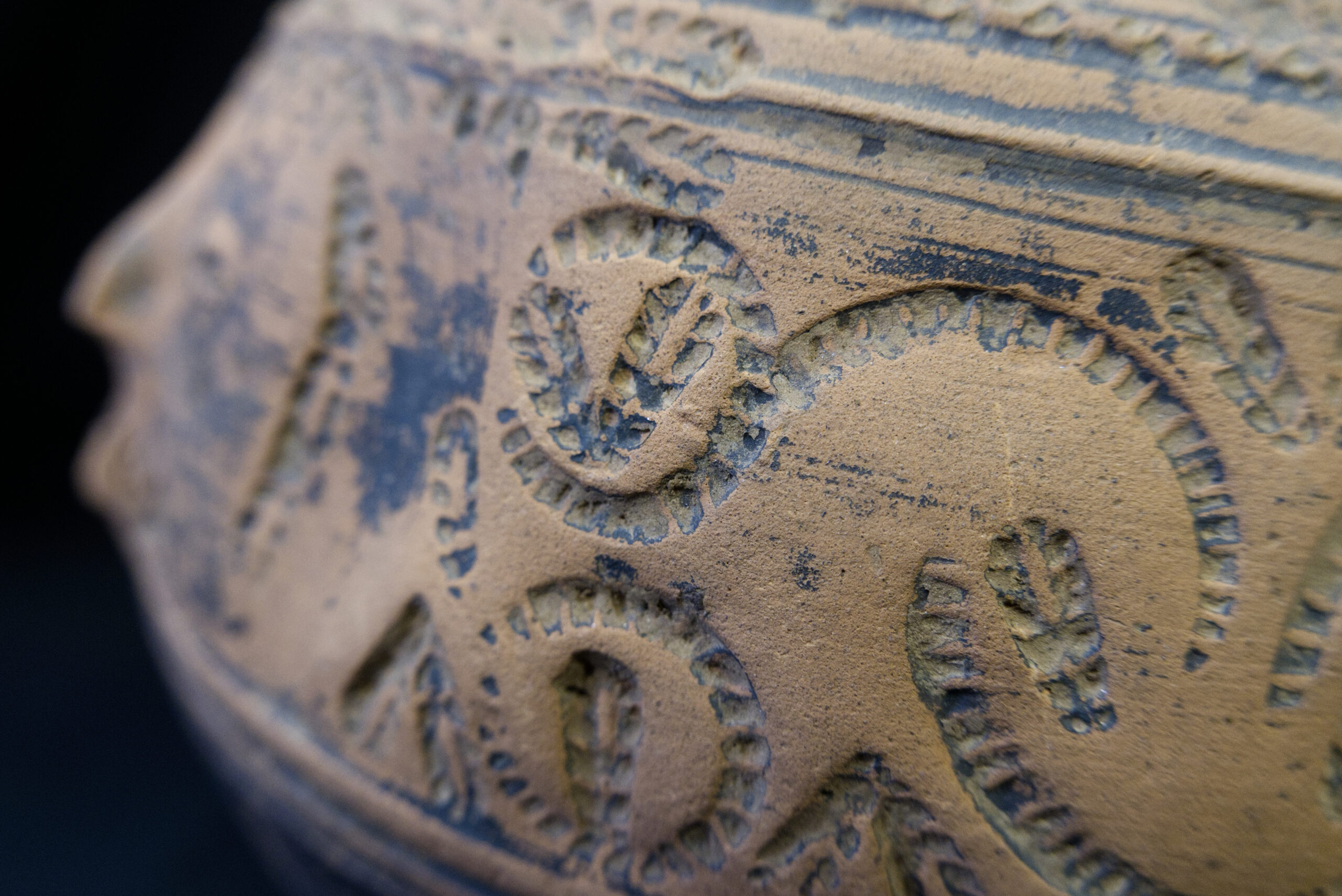
Pottery, since its invention, has exhibited a variety of decorative styles. This example is decorated with stamped decoration in the form of demi-roulettes, which were stamped onto the body of the vessel before it was fired. The main decorative feature, however, is a moulded face, formed by pinching clay to form eyes, a nose, and a mouth. Stamped decoration was also employed to give the impression of hair and the edges of the face.
Face pots, in both jar and beaker form, are thought to have their origins with the Roman legions in central and norther Italy as early as the 2nd century BC. Their usage then spread as the Roman empire expanded, eventually reaching Britain, where they have been found typically in military contexts such as major forts, or along Hadrian’s wall.
Use:
Face beakers like this are often linked to the worship of Bacchus (or Dionysus), the Roman god of wine, celebration, fertility, and theatre, but also the duality of joy and madness. Their expressive human faces may have played a role in drinking rituals. It is notable that this pot was probably buried at the same time a small temple or shrine was in use, only a short distance away. It is possible that this vessel had been used in ritual drinking and worship taking place at this shrine or in the Temple precinct inside the city walls.
It is well-attested that pottery normally for eating or drinking was utilised in graves as goods as a way of giving the dead food and drink in their journey to the afterlife. The oversized nature of this beaker shows it was made specifically for this grave, whether in association with the nearby shrine or not. This beaker is not only noteworthy for its rarity as an oversized form but for its use, not as a vessel for liquid but for a food substance.
Scientific analysis of residue inside the pot shows that it was used as a container for meat or animal fat, likely from from cattle, pigs, or sheep, as an offering and part of the burial ritual. It is notable that the other vessels in the grave contained probable diary fats, such as milk or cheese, showing that food was a central part of the funerary ritual.
Discovery:
During the excavation of a late-Roman cemetery just outside of Canterbury City walls, Archaeologists from Canterbury Archaeological Trust uncovered a small group of unusually deep graves which was surrounded on three sides by an enclosing ditch. The combination of these clearly marks out the graves is significant and likely marked out individuals of special importance within the community.
One of the graves, Grave 8, was an inhumation of an individual, possibly biologically female, who died around the age of 25-35. This person was buried in a coffin represented by 34 iron nails. They were buried wearing hobnail shoes, and grave goods included three pottery vessels. This group was comprised of a shallow bowl, dated to 270-400 AD, a miniature everted-rim jar dated to AD180-370 AD. The final vessel, an over-sized face beaker, had been placed between their legs near their feet.
This beaker is regarded as unique in the Roman world as the only know face-beaker placed in a grave. Its size and careful positioning suggest that it was especially important, chosen to accompany the deceased into the afterlife. It is one of only a few known face-beakers from Britian, with face-jars much more common. It is also remarkably large for its type, with an external rim diameter of c. 100mm. Its large size may have been particularly valued during the religious rituals which this pot may have been used in. The religious nature of its use is possibly reinforced by the miniature vessel recovered from the same grave, which have been suggested to have been used for burning incense or possibly even narcotic substances which were then inhaled.
The pots and food offerings show that the burial of this individual was carefully planned and deeply symbolic. The face beaker offers a glimpse into how the Roman community in Canterbury honoured the dead and the complex funerary rites of the Roman world.
Current Location:
This find is currently held in the Canterbury Archaeological Trust Archive.
Catalogue:
RTC-EX-13
Context 5375 – Fill of Grave 8
SF162
Exterior Rim diameter: 100mm.
Height: 265mm
Weight: 1887g