

LATE BRONZE AGE SWORD MOULDS,
HOLBOROUGH QUARRY, SNODLAND
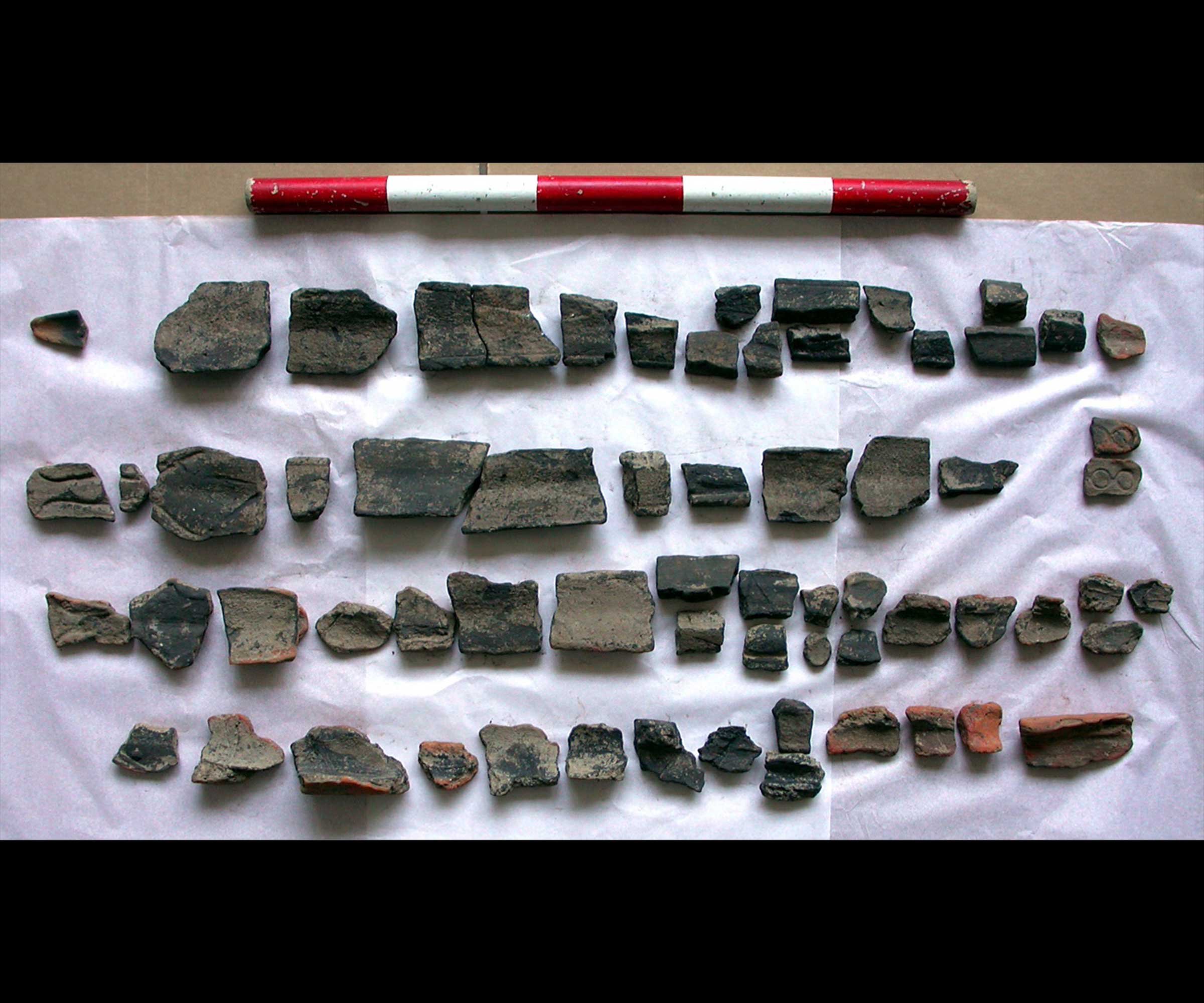
The site of a late Bronze Age settlement was identified to the east of Holborough Quarry, Snodland in 2004. A series of excavations here revealed, amongst other features, numerous rubbish pits from which various finds were recovered. These included fragments of rare baked clay moulds used for making bronze swords around 3000 years ago.
Date: Late Bronze Age (circa 1000–900 BC)
Origin
A large assemblage of baked clay sword mould fragments was retrieved from a deep, charcoal-rich rubbish pit associated with a small farming settlement in use during the late Bronze Age, around 1000–900BC.
Amongst other archaeological features, two ditches were identified across the site; one ditch marked the northern limits of the settlement, the second, southern ditch marked an internal division between areas within the settlement. Most of the sword mould fragments from the site were recovered from a single refuse pit to the south of the southern ditch and provide rare evidence for metalworking activities at this time.
Use
The moulds were used as clay casings for the production of bronze swords. Iron had yet to be introduced into this country at this time. Molten bronze would have been poured into the mould and allowed to harden. Experts from the British Museum have identified the moulds as probably being for a ‘Wilburton’ type sword. This type of weapon is well known throughout East Anglia, the Thames Valley and Hampshire, but evidence for their manufacture is very rare.
Discovery
Archaeological evidence from the site suggested the settlement included a number of rectangular and circular wooden domestic buildings, cattle enclosures and possible granaries. From the many refuse pits associated with the timber buildings, a large quantity of late Bronze Age pottery was recovered along with finds of animal bone, charcoal and other domestic waste. A number of baked clay loomweights and a bone weaving tool were also found; their presence suggesting the production of textiles within the settlement. The large quantity of animal bone indicated the keeping of livestock, and the recovery of carbonised pulses and grains the growing of cereals and vegetables. In addition, at least ten pits within the western and southern areas of the site contained cremated human bone.
The discovery of the moulds suggests, perhaps surprisingly, the possible presence of a competent swordsmith within a small farming community. However, other than the sword moulds themselves, there was little supporting evidence for metalworking at the Holborough Quarry site. An alternative suggestion is that rather than the moulds having been merely thrown away, they might have been deliberately placed in certain features of the settlement as part of some kind of symbolic act.
The moulds are deemed to be of national importance and their discovery means that Holborough Quarry has become a ‘type site’ for sword production in the late Bronze Age.
Current Location
Canterbury Archaeological Trust archives.
Catalogue Entry
Site code: HQS EX 04
SF66 sword mould fragments in baked clay mainly from context (700). Most fragments are from pit [335]. Total weight 1,831g.
72 fragments belong to inner valves for casting swords. A high proportion of them can be interpreted as belonging to just four valves representing two complementary pairs. There are, however, other fragments which cannot belong to these and must represent a minimum of three or four further valves based on recurrent elements for casting hilt grips. One of the reconstructable valves is substantially represented, but the others have more missing than is present. There were also 9 unattributed sword fragments.
According to the Portable Antiquities Scheme (published 23 October 2014):
“Wilburton swords are recognisable by their short curved ricasso, prominent shoulders and flared hilt terminal. The swords have a leaf shaped blade and compared to earlier swords there are fewer and larger rivet holes”.
https://web.archive.org/web/20141023190135/http://finds.org.uk/bronzeage/objects/swords
A reproduction of a Bronze Age Wilburton-type sword can be viewed here:
Bronze age sword, Wilburton type – Show and Tell – Bladesmith’s Forum Board (bladesmithsforum.com)